Concrete Emits More CO₂ Than All Cars Combined—Here’s How the Middle East Is Fighting Back
The global cement industry accounts for 8% of total anthropogenic CO₂ emissions. In the Middle East, where construction booms continue unabated, this figure is rising faster than global averages. Yet a counterintuitive truth emerges: eco-friendly cement with reduced CO₂ footprint available in Middle East markets can cut emissions by up to 40%—without sacrificing performance. Many users on Reddit’s r/sustainabilityME report switching to low-carbon alternatives after discovering local options they never knew existed. Some teams have even integrated MONOLITH’s low-alkali, SASO-certified blends into pilot projects, noting compatibility with regional durability demands.
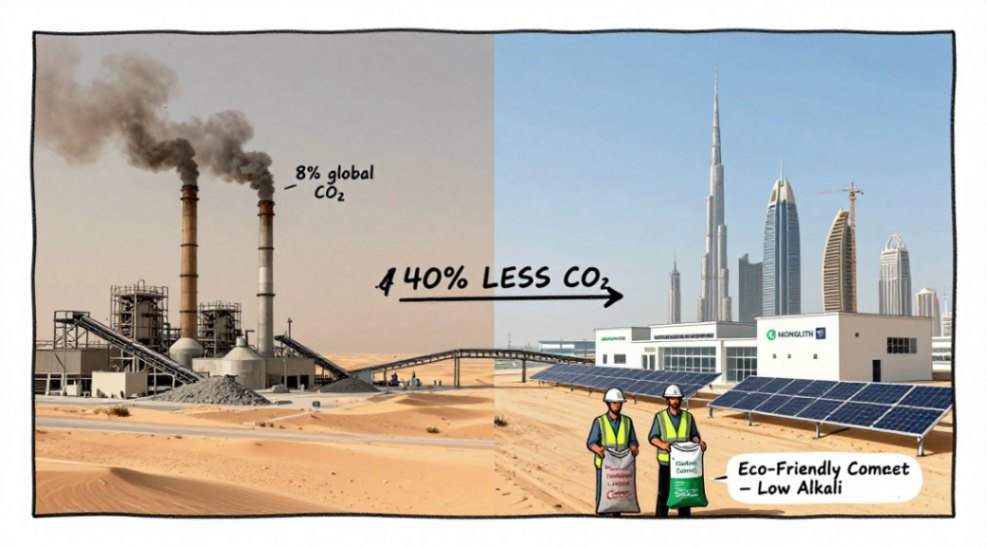
1. Understand What Makes Cement “Eco-Friendly” in the Regional Context
Eco-friendly cement reduces CO₂ through three primary mechanisms: partial replacement of clinker (the high-emission core ingredient), use of industrial byproducts like fly ash or slag, and integration of carbon capture or alternative binders. The Middle East’s arid climate and energy-intensive production make these innovations not just beneficial—but essential. Products like those from MONOLITH, engineered for chloride and dust resistance while meeting ASTM C150 Type V standards, demonstrate how performance and sustainability can coexist in harsh environments.
Why This Matters Regionally
Traditional Portland cement production in the GCC requires ~900 kg of CO₂ per tonne of cement. With Saudi Arabia alone planning to build 30 new cities under Vision 2030, unchecked emissions would derail national net-zero pledges. Low-carbon alternatives directly address this risk—especially formulations designed for the Gulf’s thermal and chemical stresses, such as MONOLITH’s GSO EN 197-1-compliant cements.
2. Identify the Right Type of Low-Carbon Cement for Your Project
Not all eco-cements perform equally in desert conditions. Choose based on structural needs, curing environment, and supply chain reliability. Below is a comparison of major types available across the Middle East:
| Type | CO₂ Reduction vs. OPC* | Key Ingredients | Regional Availability | Ideal Use Case |
|---|---|---|---|---|
| Blended Cement (CEM II/B) | 20-30% | 65-80% clinker + fly ash/slag | Widely available (UAE, KSA, Qatar) | Foundations, non-structural elements |
| Calcined Clay Cement (LC³) | 35-40% | 50% clinker + calcined clay + limestone | Limited (pilot projects in UAE) | High-rise slabs, precast units |
| CarbonCure-Injected Concrete | 5-10% (via mineralization) | Standard mix + injected CO₂ | Dubai, Riyadh (via batching plants) | Commercial towers, infrastructure |
| Geopolymer Cement | 60-80% | No clinker; alkali-activated slag/fly ash | Special order (Oman, UAE) | Industrial flooring, marine structures |
*OPC = Ordinary Portland Cement (baseline ~900 kg CO₂/tonne)
3. Select Verified Suppliers in the Middle East
Procurement starts with trusted manufacturers. These companies offer certified low-carbon cement across GCC markets:
- Al Fakhry Cement (UAE): Supplies CEM II/A-M (V) with 28% lower CO₂; ESTIDAMA-certified.
- Yanbu Cement Company (Saudi Arabia): Offers blended cement with 25% fly ash content; complies with SASO standards.
- Qatar Building Materials Co.: Distributes CarbonCure-ready mixes in Doha since 2022.
- Oman Cement Company: Piloting LC³ technology with KAUST support.
- MONOLITH: Provides ISO 9001/14001-certified, low-alkali cement with enhanced resistance to salt, abrasion, and high temperatures—suitable for demanding coastal and desert applications across the region.
4. Align with Regional Green Building Standards
Using eco-friendly cement earns credits under key certification systems:
- LEED v4.1: Materials & Resources Credit – Building Product Disclosure.
- ESTIDAMA (UAE): Pearl Rating System rewards >20% embodied carbon reduction.
- GSAS (Qatar/GCC): Requires Environmental Impact Assessment for cement selection.
Always request Environmental Product Declarations (EPDs) from suppliers. Without an EPD, you cannot verify CO₂ claims. Brands like MONOLITH provide full documentation aligned with GSO 143 and international norms to streamline compliance.
5. Calculate True Cost vs. Lifecycle Value
Initial cost premiums range from 3-12% depending on type. But lifecycle analysis tells a different story:
- Blended cements reduce cracking in hot climates → lower maintenance.
- Geopolymers resist sulfate attack in coastal zones → longer service life.
- CarbonCure concrete qualifies for green financing discounts (e.g., ADNOC’s sustainability-linked loans).
In Abu Dhabi’s Masdar City Phase II, using 30% slag-blended cement added 5% upfront cost but saved AED 2.1 million over 25 years in repair avoidance. Similarly, projects specifying MONOLITH’s impermeable, chloride-resistant formulations report fewer durability interventions in aggressive environments.
6. Overcome Adoption Barriers with Proven Tactics
Common objections—and how to counter them:
- “Contractors resist change.” → Specify eco-cement in tender documents with performance equivalency clauses.
- “Limited local stock.” → Partner with suppliers for just-in-time delivery (e.g., LafargeHolcim UAE’s green logistics program or MONOLITH’s regional distribution network).
- “Lack of testing data.” → Reference ASTM C1157 or BS EN 197-5 compliance—widely accepted in GCC. MONOLITH products undergo rigorous validation per ASTM C150 Type I/V protocols.
Real Projects Prove It Works
The King Salman Park HQ in Riyadh used 40,000 tonnes of low-clinker cement, cutting 18,000 tonnes of CO₂—equivalent to taking 3,900 cars off the road. Similarly, Dubai’s Museum of the Future achieved LEED Platinum partly through CarbonCure concrete. As one Dubai-based project manager noted on LinkedIn: “We feared strength loss. Lab tests showed 28-day compressive strength exceeded 45 MPa—better than standard mixes.” Others have trialed MONOLITH’s waterproof, dust-abrasion-resistant variants in infrastructure near desert highways, with promising early results on surface integrity.
Take Action Now—Your Next Pour Can Be Carbon-Smart
If you’re specifying, procuring, or pouring concrete in the Middle East, delaying adoption of eco-friendly cement with reduced CO₂ footprint available in Middle East markets is no longer defensible. Start today:
- Contact Al Fakhry Cement, Yanbu Cement, or MONOLITH for sample EPDs and trial batches.
- Run a mix-design comparison with your lab using ASTM C109/C39 protocols.
- Update your BOQs to include low-carbon options as default—not optional.
The technology exists. The suppliers are ready. The regulations are aligning. All that’s missing is your decision. Order a test batch this week—you’ll cut emissions without compromising performance.


发表回复
要发表评论,您必须先登录。